






Back
SEARCH AND PRESS ENTER
Recent Posts

The Future of Healthcare is in the Home

By Joe McMenamin and Joel Embry

Why Care is Moving Home

In 2040, health professionals will care for patients primarily in their homes, in person and virtually. There will still be hospitals, of course, including emergency departments, especially at academic medical centers and level I trauma centers. There will still be nursing homes, urgent care centers, and doctors’ offices, and from time to time patients will still need them. But they will be fewer in number and secondary, not primary locations for care. In fact, many of these changes are already underway, and may be largely complete well before 2040.

There are several reasons.

First, the United States simply cannot afford to continue to devote 18% of GDP to healthcare. Our debt is already a stupefying, ominous $3.7 X 10¹³ and growing at a rate of $1013 every 100 days.[1] Interest on the national debt already exceeds annual spending on Medicare, as well as on national defense. Barring a radical change in federal government behavior, the debt is expected to exceed 145% of GDP by 2040; some say 200%. Deloitte projects that, if we continue current trends, health spending could reach a staggering $1.2 X 1013 by 2040.[2] This is untenable.

One solution, among the many needed, is to move care whenever possible to its cheapest location: the home.

CMS has determined that by 2030 all Medicare and most Medicaid services will be paid for on a value-based care (VBC) principles.[3] Healthcare providers will need to contain costs aggressively, so the drive to VBC will augment the other pressures pushing more care to the home.

Second, as the population grows, the imbalance between demand for and supply of healthcare professionals and institutions will increase even faster. Hospitals and SNFs are closing for financial and staffing problems. Those remaining open have difficulty attracting and retaining nursing and medical professionals. Many members of those professions are abandoning them for other fields.

Third, Americans are living longer, and so managing chronic illnesses longer, and will demand care at home. AARP surveys routinely find that by majorities of 75% and higher seniors prefer to remain at home.[4]

Finally, as health and healthcare improve across the population, there will be less need per capita for healthcare facilities. Evidence-based medicine will enhance the quality and safety of healthcare while reducing its cost and risk. Advances in genetics will permit fast, accurate identification of undiscovered illnesses, permitting modification of behavior to reduce risk. Personalized medicine, using an individual’s unique genetic, environmental, and lifestyle information, will promote disease prevention, diagnosis, and treatment. Inevitably, healthcare facilities, especially those not keeping up with the frenetic pace of change, will close their doors.

Benefits of Moving Care Home

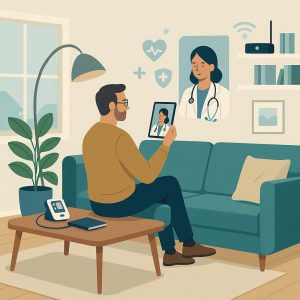
Moving care to the home is not an unhappy development. Ninety percent of US healthcare dollars go to pay for management of chronic disease.[5] For much of that, care in the home is perfectly adequate; as technology improves, the quality of home care will improve along with it. Already, we can provide dialysis, x-rays and intravenous therapy at home. AI-powered chatbots now act as first points of contact for patients, gathering information and offering basic guidance before a virtual visit with a professional. Specialists of all descriptions can see patients virtually. The hospital-at-home concept permits management of even very sick patients in their own homes, and diminishes the patient’s exposure to the microbial milieu of the hospital and its risks of infection. Smart homes permit health monitoring, safety features such as automatic stove shut-offs, medication reminders, and connectivity to family and emergency services. The future will bring exponential expansion of these trends.

Stimulated by the pandemic, distance care continues to grow more capable, accessible, and accepted. Remote monitoring, which can be done as readily from home as in a hospital, can provide a cost-effective way to track the progression of chronic illness and to identify decompensation early, before it requires admission. Such prevalent and consequential conditions as diabetes, COPD, hypertension, some dysrhythmias, and heart failure can be readily monitored with relatively inexpensive, off-the-shelf devices already on the market. Traditional videoconferencing telemedicine can address many acute problems; that capability will only increase with time.


Care at home will also help rectify the isolation problem so common among seniors. Loneliness and isolation have serious effects, and remaining at home with loved ones, close to neighbors and friends, is an antidote.[6] The home will grow not only more attractive as a site of care, but, increasingly, a superior one. To be surrounded by one’s loved ones and friends is a bulwark against isolation.

Falls are a serious problem, often in seniors a cause of not only serious morbidity but even mortality.[7] Falls can occur at home. The probability of a fall is higher in unfamiliar environments such as hospital or SNF rooms, however. In the home, we will see risk assessments personalized for both the patients themselves and their environment, exercise programs to improve balance and health, and tailored safety features. Falls will remain a problem, but will become less prevalent.

Communities will increasingly be designed to make it easier for patients to gain access to the outdoors and engage in safe, healthful activities such as walking or bike-riding.[8] The benefits of exercise are well-established, and neighborhoods of the future will be constructed to encourage residents to enjoy and thrive from more interaction with nature.

AI will further enable care in the home. Existing AI systems can combat loneliness, falls, hypertension, diabetes, and heart failure, to name just a few. New uses are being developed every day. As AI improves, dependence on in- person services, and certainly in-person services at clinics and other official healthcare locations, will decline. And AI will benefit seniors in ways beyond classic healthcare. AI systems can recognize speech, filter sounds, find objects or patterns, remember forward and remind on time, detect common mistakes, and so forth. As we move towards generative AI, RPM will grow capable of predictive risk assessment, caregivers will enjoy streamlined work flows (documentation, scheduling, training), and patient care will become ever more patient-specific (treatment plans, medication management, etc.)

Community development will evolve

Mixed-use, walkable neighborhoods will be planned and developed and homes will be built to specially accommodate the requirements of seniors preferring to remain at home.

Universal design is already a common feature of many residences in communities for seniors. AI and Virtual/ Extended Reality will create more personalized, adaptable, and accessible products and environments. The concept will be expanded beyond individual homes to entire neighborhoods. Different types of housing, such as tiny houses and compounds, will become home to more people. There will be more thoughtful and abundant green space to encourage walking and human interactions. These features will not only make it easier to remain at home longer; they will contribute to the health of residents.

CONCLUSION

For many reasons, in future much more care will be provided in the home. Patients, their families, their providers, and the payers, private and governmental, will all benefit. We should prepare now.

References

  1. Michelle Fox, “The U.S. national debt is rising by $1 trillion about every 100 days,” CNBC 4 March 2025, https://www.cnbc.com/2024/03/01/the-us-national- debt-is-rising-by-1-trillion-about-every-100-days.html
  2. Deloitte, “Breaking the cost curve,” 2021, https://www.deloitte.com/us/en/insights/industry/health-care/future-health-care-spending.html
  3. CMS Innovation Center Strategic Refresh, 2021, https://www.cms.gov/priorities/innovation/strategic-direction-whitepaper (“All Medicare beneficiaries with Parts A and B … [and] [t]he vast majority of Medicaid beneficiaries will be in a care relationship with accountability for quality and total cost of care by 2030.”)
  4. See, e.g., AARP Press Room, “New AARP Report: Majority of Adults 50-plus Want to Age in Place, But Policies and Communities Must Catch Up,” 12.10.24, https://press.aarp.org/2024-12-10-New-AARP-Report-Majority-Adults-50-plus-Age-Place-Policies-Communities-Catch-Up
  5. CDC, “Fast Facts: Health and Economic Costs of Chronic Conditions,” 8 August 2025, https://www.cdc.gov/chronic-disease/data-research/facts-stats/ index.html
  6. See, e.g., Vivek H. Murthy, “Our Epidemic of Loneliness and Isolation,” 2023, https://www.hhs.gov/sites/default/files/surgeon-general-social-connection- advisory.pdf
  7. Vaishya R, Vaish A. Falls in Older Adults are Serious. Indian J Orthop. 2020 Jan 24;54(1):69-74. doi: 10.1007/s43465-019-00037-x. PMID: 32257019; PMCID: PMC7093636.
  8. CDC, “Strategies for Access to Places for Physical Activity,” 27 Jan. 2025, https://www.cdc.gov/physical-activity/php/strategies/access-to-places.html
Joseph_P_McMenamin

Joseph P. McMenamin, MD, JD, FCLM

Joseph P. McMenamin is a physician-attorney who advises healthcare providers on the law of digital health and of artificial intelligence. With his collaborator, real estate developer, Joel Embry, Joe is also the co-founder of Civic Telehealth, which aims to enable seniors to remain in their homes longer and in better health than they otherwise could.
Joel Embry

Joel Embry, CEO of Civic Software

Joel Embry is a community developer and consultant based in Jacksonville, Florida. He has over 35 years’ experience in commercial, office and residential community development as owner and CEO of Civic Software, Inc. He has led the planning, entitlement and implementation of mixed-use projects in Florida and Georgia. In addition to developing 8 residential communities and commercial properties on Amelia Island, Florida, including the award-winning New Urbanism neighborhood Amelia Park, Joel has served as Owner’s Representative in the planning and permitting of the 400-acre Summer Beach Resort and Ritz-Carlton Hotel on Amelia Island, Clark’s Grove Traditional Neighborhood in Covington, GA, and the 2,000-acre mixed-use Welaunee Critical Area Plan in Tallahassee, FL.

Currently, as Managing Member of Civic Telehealth LLC and Oceanic Data Centers LLC, Joel is engaged in community health care applications and development of data center facilities + telecommunications infrastructure.