

Back
SEARCH AND PRESS ENTER
Recent Posts

Harnessing AI to Personalize Care for Brain Metastases

By Saahil Chadha

ChatGPT was released during my first semester of medical school, and it immediately transformed the way that I learned. Suddenly, I was able to use AI to break down complex physiology, generate clinical vignettes, and walk through diagnostic reasoning step by step. As I progressed, I soon realized the same technologies helping me to study for exams were quickly being applied to patient care, helping with clinical decisions and treatment planning.

Rather than simply using these tools, I became increasingly curious about how they worked and what their limitations might be in clinical settings. With an interest in oncology, I was especially drawn to questions about whether AI could meaningfully help address some of the uncertainty that surrounds cancer care. This interest led me to pursue a dedicated research year at Yale, working with Dr. Sanjay Aneja. Our lab leverages deep learning to develop image-based biomarkers for cancer patients, and my work in particular focuses on improving prognostication for lung cancer patients with brain metastases.

The problem

For patients with lung cancer, the development of brain metastases is often a clinical and emotional turning point. Occurring in up to forty percent of this population, such intracranial tumors can cause neurologic symptoms, cognitive decline, and highly variable survival.1 Some patients live for years with aggressive therapy, while others decline rapidly despite similar treatment, making high-stakes decisions, such as surgery, radiation, or systemic therapy, especially difficult. Indeed, brain metastases vary widely in size, location, growth pattern, vascularity, and histology, even among patients with the same primary tumor subtype. Traditional prognostic tools, based on clinical factors, capture population-level trends, but they are less informed by the underlying biology driving outcomes in individual patients. Rich quantitative information embedded in radiologic scans, tissue slides, and longitudinal clinical data remains underutilized, which led us to ask: what if AI could integrate these diverse datasets to produce patient-specific predictions that meaningfully inform clinical decision-making?

AI and Multimodal Modeling

A Published Dataset

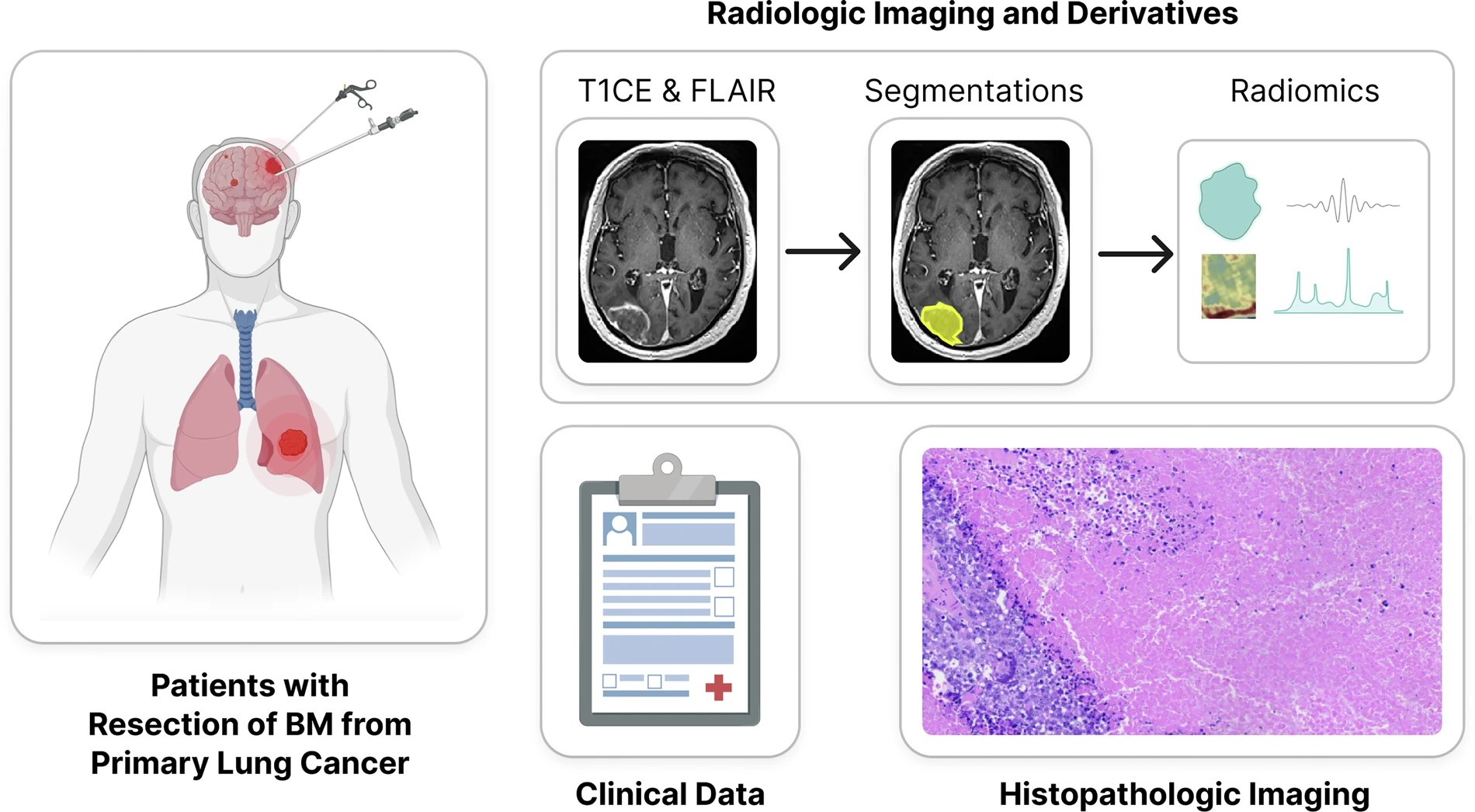
To explore the potential of AI in brain metastases, our team partnered with Dr. Don Nguyen and Dr. Darin Dolezal in the Department of Pathology at Yale to assemble a dataset designed to capture the complexity of lung cancer brain metastases. A key strength of our dataset is its multimodal design, which integrates multiple types of information from the same patients, including imaging, pathology, and clinical data. Each of these modalities provides a different window into the biology of the tumor, and integrating them allows a more complete, patient-specific view than any single type of data could provide. The fully annotated dataset is publicly available through The Cancer Imaging Archive at the National Institutes of Health, offering a resource for reproducibility and collaboration.2

The dataset links three core components:

  • Pre-operative brain MRI, including multiple imaging sequences.
  • Matched whole-slide histopathology images from brain metastasis tissue.
  • Detailed clinical data, including patient demographics, tumor characteristics, key molecular markers, and established prognostic scores.

By aligning these modalities at the patient level, we sought to create a more faithful representation of the disease. For radiologic imaging, brain metastases were segmented to delineate tumor boundaries, and radiomic features were extracted to quantify tumor shape, intensity, and texture, properties that may reflect growth patterns, vascularity, and surrounding edema. Digitized whole-slide histopathology images were also included, providing the foundation for AI tools that could analyze subtle histologic patterns beyond traditional descriptors such as grade or morphology.

Making the dataset publicly available supports external validation, methodological comparison, and broader participation, particularly for trainees and early-career researchers who may lack the resources to assemble large multimodal datasets independently. In a rapidly evolving field like AI in oncology, shared benchmarks are essential for meaningful progress, and the integration of imaging, pathology, and clinical data makes this dataset uniquely positioned to advance patient-specific modeling.

Ongoing Work in Survival Prediction

Building on this foundation, our lab is also actively exploring deep learning models for survival prediction. Traditional survival models, such as Cox proportional hazards models, are interpretable and familiar to clinicians, but they have limitations. They assume simple relationships between variables and struggle with high-dimensional inputs, like the data that we extract from images. Complex interactions such as how tumor shape modifies the prognostic significance of clinical variables are difficult to capture.

Preliminary results from our ongoing work suggest that combining quantitative radiologic imaging features with clinical data may improve prognostic accuracy compared with clinical information alone. In parallel, Dr. Greg Breuer is leading efforts to apply AI to digitized pathology slides, allowing the models to detect subtle patterns in cells and surrounding tissue that are invisible to the naked eye. Bringing pathology and clinical data together in this way may reveal new insights, particularly for predicting patient outcomes.

Together, these approaches represent a shift in how prognostic information can be captured, moving from simple summary descriptors toward richer, biologically informed representations that better reflect the complexity of individual tumors. While this work is ongoing, early results are encouraging and highlight the potential of multimodal AI to provide patient-specific insights without requiring new tests or experimental assays.

Toward Point-of-Care Decision Support

The goal is to embed these models within clinical workflows. In practice, this could mean systems that automatically extract radiologic imaging features, pathology embeddings, and clinical variables from the electronic health record to provide tailored decision support. Such tools could help clinicians weigh treatment options, identify patients for clinical trials, and have more informed prognostic conversations while preserving clinician judgment. Crucially, these tools are designed to support rather than replace physicians, offering additional insights to help improve patient care.

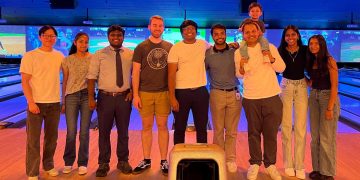
Saahil, Dr. PI and team members

Building Scalable and Ethical AI

As AI becomes increasingly integrated into healthcare, technical innovation must go hand in hand with ethical and practical safeguards. Issues such as scalability, data privacy, and bias are central to responsible deployment, also impacting public perception and acceptance.3 Ongoing work at the Aneja Lab includes developing computationally efficient neuro-oncologic image segmentation models, exploring federated learning approaches to enable multi-institutional collaboration without centralized data sharing, and systematically evaluating model performance across patient subgroups to promote equity.4

The promise of AI in oncology lies not just in creating better models, but in building systems that are trustworthy, transparent, and aligned with clinical realities, helping make patient care more precise, personalized, and data-driven.

References

  1. Sacks, P. & Rahman, M. Epidemiology of Brain Metastases. Neurosurgery Clinics of North America 31, 481–488 (2020).
  2. Chadha, S., Sritharan, D.V., Dolezal, D. et al. Matched MRI, Segmentations, and Histopathologic Images of Brain Metastases from Primary Lung Cancer. Sci Data 13, 40 (2026). https://doi.org/10.1038/s41597-025-06353-2
  3. Khullar D, Casalino LP, Qian Y, Lu Y, Krumholz HM, Aneja S. Perspectives of Patients About Artificial Intelligence in Health Care. JAMA Netw Open. 2022;5(5):e2210309. doi:10.1001/jamanetworkopen.2022.10309
  4. A. Avesta, Y. Hui, M. Aboian, J. Duncan, H.M. Krumholz, S. Aneja. 3D Capsule Networks for Brain Image Segmentation. American Journal of Neuroradiology May 2023, 44 (5) 562-568; DOI: 10.3174/ajnr.A7845

Saahil Chadha

MD Candidate, Class of 2027, Yale School of Medicine

Saahil Chadha is a fourth-year medical student at Yale School of Medicine. Originally from Excelsior, Minnesota, he studied computer science at University of California, Berkeley, before working as a software engineer at Amazon. He later brought this technical foundation into medicine, where his interests lie at the intersection of artificial intelligence, cancer imaging, and clinical care.

At Yale, Saahil conducts research in the Aneja Lab, where he develops AI models to analyze radiologic and pathologic data with the goal of creating imaging-based biomarkers that can personalize treatment and improve outcomes for cancer patients. His current work focuses on how multiple data sources can be integrated to improve prognostication, with particular attention to patients with brain metastases.

Looking ahead, Saahil plans to pursue residency in internal medicine while continuing his research on AI applications in medicine. Beyond research and clinical training, he is interested in medical education and community-building. He also plays viola in the Yale Medical Symphony Orchestra.

10

Sanjay Aneja, MD

Sanjay Aneja, MD is an Assistant Professor within the Department of Therapeutic Radiology at Yale School of Medicine. Dr. Aneja is a physician scientist whose research group is focused on the application of machine learning techniques on clinical oncology. He received his medical degree from Yale School of Medicine and served as class president. During medical school he completed a research fellowship at the Department of Health and Human Services in large scale data analysis. He later completed his medicine internship at Memorial Sloan Kettering Cancer Center followed by his residency in radiation oncology at Yale-New Haven Hospital. During his residency he completed his post-doc in machine learning at the Center for Outcomes Research and Evaluation (CORE) receiving research grant from IBM Computing. He is currently a recipient of an NIH Career Development award, an NSF research grant, and an American Cancer Society research award.