Back
SEARCH AND PRESS ENTER
Recent Posts

Context Determines Outcome

By Eric Hoyeon Song, MD, PhD

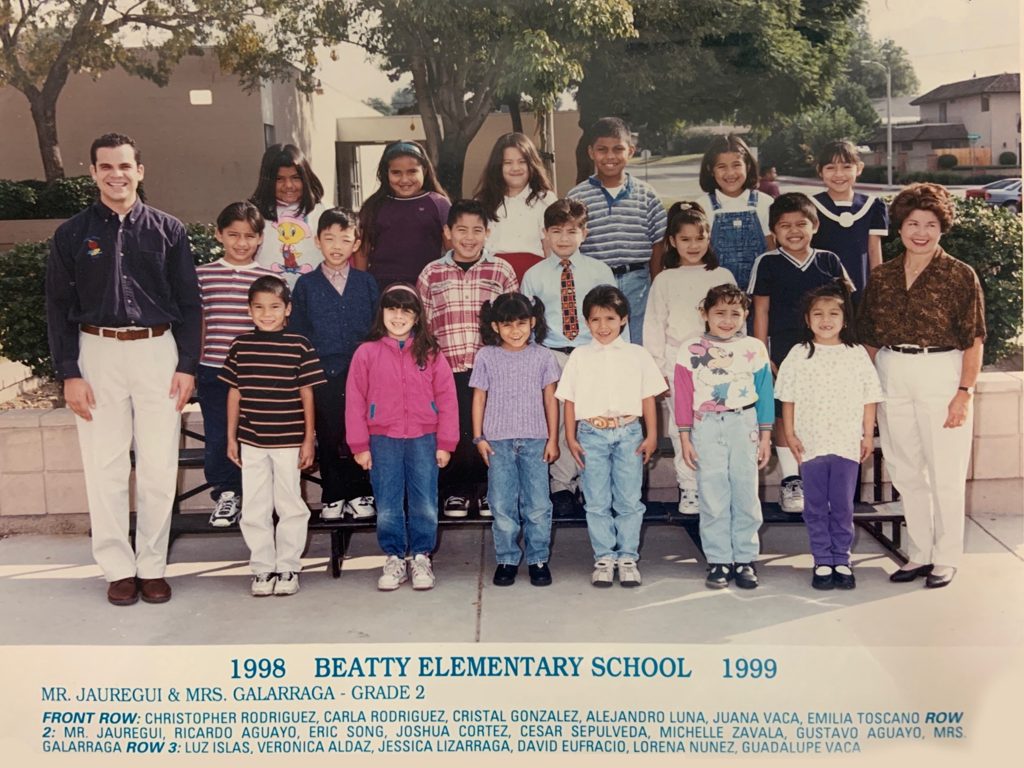
Mr. Jauregui's ESL Class at Beatty Elementary School. 1998-1999 School Year

I didn’t arrive at science through a straight path. I arrived through displacement (geographic, cultural, linguistic) and through a series of people who saw something in me before I could see it myself.

Following the Asian financial crisis in 1998, my family moved from Korea to California. I look back at that decision with enormous admiration for my parents. They left their support systems to come to a country without language or jobs, and they spent night and day building a life for us. We rarely saw them. There were few moments of joy, and the stress of displacement was constant. But watching them take that leap was my first lesson in what it takes to succeed: perseverance, grit, and the willingness to step into the unknown.

Finding a Home in School

School became my second home. My start was in Mr. Jauregui’s English as a Second Language classroom, where I learned more Spanish than English from my peers. He didn’t want us labeled as students who couldn’t keep up. His singular goal was to get us out of those classrooms, and his commitment got me out the next year. Leaving ESL opened up subjects I excelled at, like math, and my teachers continued to foster that momentum. My fifth-grade teacher, Mr. McDonald, who became my godfather, provided mentorship that went far beyond schooling. He spent long hours after class teaching me how to stand up for what’s right and how to see the world as full of possibility. I attribute my love for education and my desire to stay in academia to the belonging and comfort I found at school during those years.

That comfort didn’t last. As I reached adolescence, my parents were working longer hours and I felt unchallenged and invisible. I fell in with a group of older Korean-American kids who offered the sense of identity and belonging I was searching for. For a while, I mistook that solidarity for purpose. I made choices I’m not proud of, and I was eventually dismissed from my high school. It took separation from that group, and the slow, painful work of remembering who I actually was, to find my way back. I thought about Mr. McDonald and the conversations we’d had about seeing right from wrong. I thought about Mr. Jauregui and how he had embraced me despite our inability to communicate. I thought about my parents and the environment they had worked so hard to provide. Teachers and friends at my new high school helped me recover, and I began rebuilding.

From Photography to Medicine

I started college as a photography major. I was drawn to the way a camera could make the invisible visible, how light, angle, and timing could reveal something that was always there but that no one had stopped to look at. But I found myself increasingly pulled toward education and science, and toward being of service. I became an EMT, a campus coordinator for Teach for America, and founded a nonprofit called Project L to raise awareness of cystic fibrosis. Through that work, I connected with families with kids living with CF. Despite a difficult prognosis, all the families embodied hope. Their story clarified something for me: I wanted to work with children facing life-limiting diseases, and I wanted to do it at the intersection of research and patient care.

That conviction led me to Yale’s MD/PhD program, where I trained under Akiko Iwasaki in immunology and drew on mentors across disciplines, from neurology to biomedical engineering. The pivot from photography to medicine wasn’t as sharp as it sounds. Both are fundamentally about observation, training your eye to notice what others miss, and then having the discipline to frame it in a way that communicates something true. When I entered ophthalmology, the connection became literal. I was studying the organ of sight itself.

Following the Question

Each stage of my training reshaped the question I was asking. Nanoparticle engineering taught me that where something ends up in the body determines how the immune system responds to it. Mucosal immunity reinforced that lesson. And when I turned to the central nervous system, I found it again: the brain’s lymphatic drainage doesn’t just passively clear fluid, it actively shapes immune responses. The same antigen produces a completely different outcome depending on the anatomical context in which it’s encountered.

That pattern, that context is not background noise but the primary variable, became the framework I now call anatomical immunity, trying to unravel how anatomical design guides immune responses, both at the molecular and cellular level. It eventually led me to discover that the eye has its own lymphatic drainage system, something the field had assumed didn’t exist. From that finding came LS-VEGF-C, a therapeutic I engineered and am now working to bring to patients through Rho Bio, the company I co-founded. As an Assistant Professor at Yale, I’m building a lab organized around the same principle I’ve been circling since childhood; that the environment in which something happens shapes everything about the outcome.

What It Has Meant Personally

Science gave me a language for something I’d been feeling my whole life. The immigrant experience is, at its core, an experiment in context. You take the same person and change their environment, and everything shifts. The immune system does the same thing. A T cell that encounters antigen in the meninges behaves differently than one that encounters the same antigen in a lymph node. The context isn’t incidental. It’s determinative.I think about that a lot when I consider what this path has meant to me. There were so many points where things could have gone differently. If Mr. Jauregui hadn’t pushed to get me out of ESL. If Mr. McDonald hadn’t spent those extra hours after school. If the teachers at my second high school hadn’t given me a chance when I hadn’t earned one yet. If my parents hadn’t made sacrifices I still don’t fully understand. Each of those moments changed my context, and each one changed what I became.

That’s part of why I care so much about mentorship now. I know what it feels like to have someone see potential in you before you can see it in yourself, and I know what it feels like when no one does. As I build my lab and begin training the next generation of scientists, I carry that with me. The students and trainees I work with come from all kinds of backgrounds, and I want to create the kind of environment that was created for me: one where people are valued for their curiosity, given room to fail, and supported through the parts of the journey that don’t look like progress.

I’ve been fortunate to be supported by people and institutions that understood this: the Paul and Daisy Soros Fellowship, the Burroughs Wellcome Fund, mentors like Akiko who modeled what it looks like to think structurally about immunity. The awards and recognition have been gratifying, but what matters most to me is the feeling that the science and the life are telling the same story. For every hardship or instability I felt from being a stranger in a foreign place, I found solace in mentorship and guidance. Grit is important, but it is just as important to have people behind you, nudging you in the right direction. That throughline from displacement to discovery isn’t a coincidence. It’s the whole point.

Eric Hoyeon Song, MD. PhD

Assistant Professor Adjunct of Ophthalmology & Visual Science and Immunobiology