Back
SEARCH AND PRESS ENTER
Recent Posts

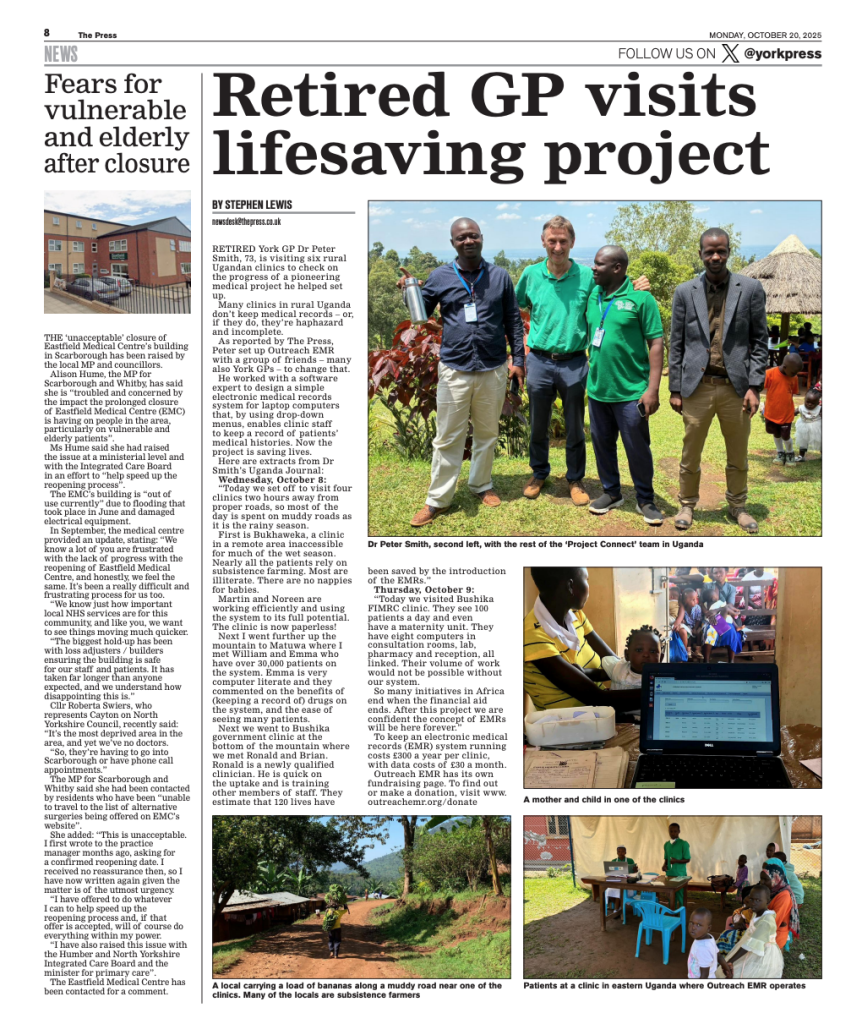
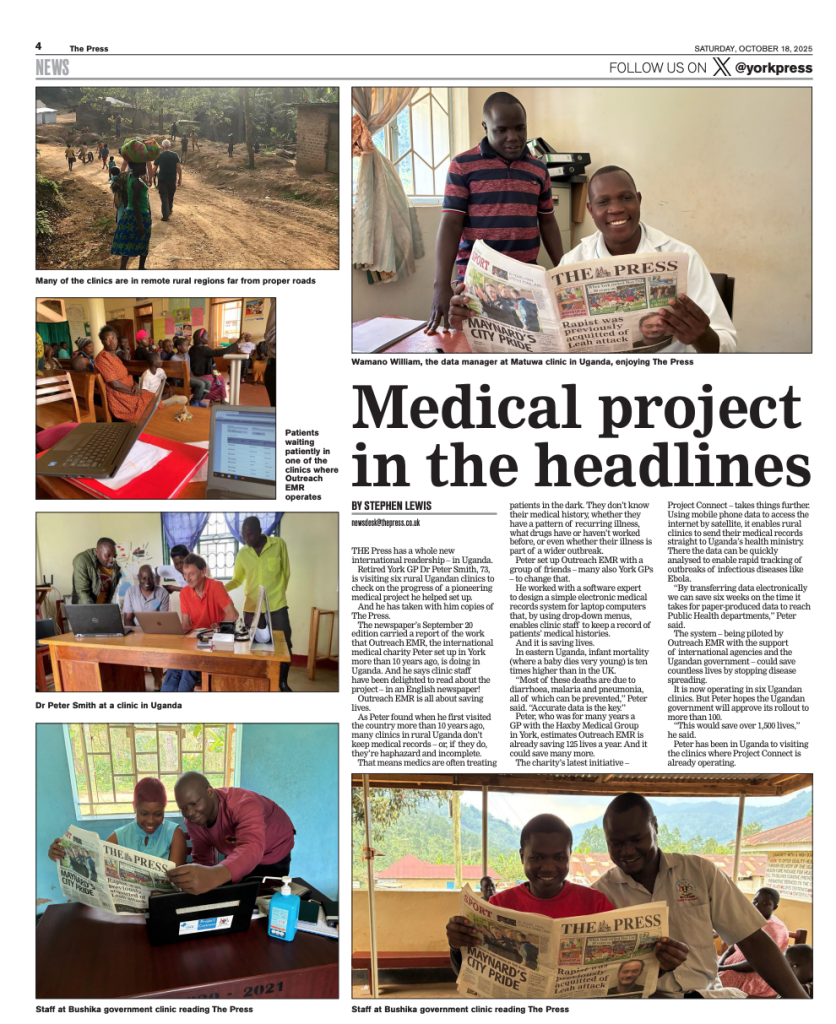
We are a UK based registered not for profit charity established by UK Doctors operating in nine low and middle income countries across the world, providing electronic medical record systems free for clinics, often operating remotely without reliable power or internet. http://outreachemr.org/

Creating Healthcare Infrastructure
Where Basic Systems Were Absent:

A Conversation with Dr. Peter Smith

Building Healthcare Where Records Never Existed

Global health conversations often focus on breakthrough technologies, major funding initiatives, and sweeping policy reforms. Throughout this issue of BioHealth, we feature leaders and innovators working across many dimensions of global healthcare transformation. Yet some of the most meaningful advances begin much more quietly, in places where even the most basic healthcare infrastructure does not exist.

What makes the work of Peter Smith, MBChB, DRCOG, DCH, MRCGP, founder of Outreach EMR, particularly compelling is precisely this quality. His work is not built around complexity or large scale technological ambition, but around a simple and fundamental question: how can healthcare systems function safely and effectively when patients have no reliable medical records at all?

In this cover story, Dr. Smith reflects on how a single moment while volunteering in a remote clinic in Uganda fundamentally changed his understanding of healthcare delivery. What began as an encounter with the absence of even the most basic patient documentation ultimately evolved into the development of electronic medical record systems now supporting underserved clinics across multiple low resource countries. Over the past decade, Outreach EMR has helped establish digital health infrastructure in settings where medical records often never previously existed.

What emerges from Dr. Smith’s experience is an important reminder that global health progress is not always driven by the most advanced technologies or the largest international initiatives. In many settings, meaningful impact comes from addressing fundamental gaps in healthcare delivery, whether through access to medications, workforce training, infrastructure, continuity of care, or reliable clinical information systems. Outreach EMR highlights how even relatively modest and practical interventions can become transformative when they address essential needs that healthcare systems cannot function safely without.

NexBioHealth Editorial Team

1. For readers who may not yet be familiar with your work, how would you introduce yourself and your mission?

We are a UK based registered not for profit charity established by UK Doctors operating in nine low and middle income countries across the world, providing electronic medical record systems free for clinics, often operating remotely without reliable power or internet.   http://outreachemr.org/   Over the past 14 years we have established Electronic Medical Records (EMR) in 20 different clinics and created over 250,000 patient records where none previously existed.  Through this experience we can demonstrate that EMR improves medical outcomes particularly in maternal care, infant mortality and immunisations, enables early detection of disease outbreaks and provides data enabled efficient deployment of resources.

2. You first encountered the absence of medical records while volunteering in Uganda. Can you take us back to that moment, and what made you decide that this was a problem you had to solve?

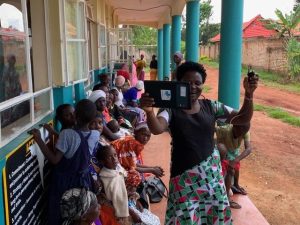
This is a photo of the very moment 15 years ago when I was volunteering in a remote clinic in Eastern Uganda, seeing 100 patients a day with no written records. Lab test requests were written on a piece of paper but nothing is wasted in Uganda and the next day the paper was put to use in the latrine. When visiting the latrine I noticed my previous day’s request for an HIV test for a patient !

Against the backdrop of Infant mortality at that time of 38 per 1000 live births and Maternal mortality of 250 per 100,000 births I realised that good data would make a huge difference and returned to the UK to ask a software colleague to write a simple EMR programme.

3. In high-income settings, medical records are often invisible because they are ubiquitous. What are the most serious, and perhaps underappreciated, consequences of not having reliable records in low-resource environments?

Evidence shows that Electronic Medical Records can save 1.3 to 1.5 million lives annually in low-resource environments.

At this time there are virtually none in Sub Sahara Africa but Outreach EMR have established EMRs that by the evidence below are probably saving 250 lives per year.

We compiled these figures from several sources including WHO, BMJ, WHO Africa, UNICEF, Global Health, UNAIDS, Global TB report, academic EMR studies from Malawi & Kenya, cancer and cardiovascular delay studies

Preventable medical errors cause 5-8 million deaths/year. Good EMRs with a chronological medical history can reduce medical and medication errors by 55-80%

Maternal and Neonatal mortality is huge in Africa with 182,000 maternal deaths/year and 1.12 million neonatal deaths. EMRs allow better antenatal tracking, referrals and medical compliance

HIV TB and Malaria mismanagement contributes to the 1.1 million deaths per year from these conditions. EMRs allow better follow up, appointment tracking and compliance and can reduce death rates by 10%

Epidemic Response delay such as Covid, Cholera and Ebola is common in Africa and our EMRs provide the opportunity for instant Public Health data collection via interoperability rather than a 6 week delay using paper records. Early detection saves an estimated 20,000 -100,000 lives

Chronic Disease Mismanagement. Non-communicable diseases such as hypertension, diabetes, asthma and epilepsy account for 1.5 million deaths across the continent. Better long term tracking and records conservatively reduces mortality by 3-5%

Emergency mismanagement and Delayed or incorrect Diagnosis

Lack of history and previous records, wrong meds, missed allergies, missed diagnosis and lab tests contribute to over 120,000 deaths

Category Estimated Lives Lost / Year
Medical Errors 1,000,000
Maternal & Neonatal Mortality 100,000–150,000
HIV, TB, Malaria Mismanagement 50,000–100,000
Outbreak Response Delay 20,000–100,000
Chronic Disease Mismanagement 50,000+
Emergency Care Failures 20,000+
Delayed/Incorrect Diagnosis 100,000+

Why This Estimate Is Defensible

  • We used conservative estimates, often below what published studies suggest
  • We avoided double-counting by separating clinical pathways
  • We only included mortality impact, not the broader improvement in quality of life, disability-adjusted life years (DALYs), or cost savings
  • All assumptions are grounded in peer-reviewed studies, WHO/UNAIDS data, and real-world EMR implementations in Africa

4. Outreach EMR was built to be simple, low-cost, and usable with minimal training. What core principles guided its design, and what deliberate compromises were necessary to make it viable on the ground?


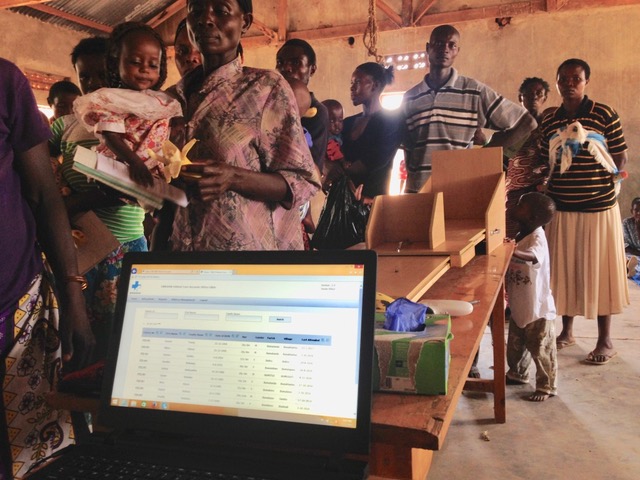
From the outset we wanted a system whose USP would be that someone without keyboard skills would be able to enter patient data within hours of being introduced to the system. The system is designed around dropdowns with the ability to enter precoded ICD 10 diseases. There are traffic light warning systems to warn unskilled workers of abnormal temperatures, MUACs and BMIs etc.

As we have developed, reporting has become more sophisticated and we recently developed a more formal training approach to new clinics in Uganda. We know that our system is not as sophisticated as in US/UK models but after 15 years appreciate that this is not a necessity to reduce present levels of mortality from malaria, diarrhoea and pneumonia.

We see chronic disease management as a growing challenge with our EMRs

The architecture is designed to support both Cloud and Desktop including Roaming (mobile) installations, ensuring data integrity and enabling continuous remote support, even where connectivity is intermittent. Our modular, plugin-driven approach not only streamlines core clinical operations but also facilitates rapid deployment of interoperability features – such as the monthly Govt health reports – which are crucial for data-driven public health decision-making

5.How is what you are building fundamentally different from traditional global health models?

Designed by clinicians who have worked on the ground in Africa
Easy to adopt in areas with unstable electricity and no IT team
We are purpose built for frontline clinics rather than hospitals
Cloud based but our clinics can work offline and sync when internet available
Easy to use for non-technical users
Free to use
Proven Interoperability using DHIS2 platform

6. From your experience, what has been the single most difficult barrier to implementation? And has that answer changed over time?

Initially there were two main barriers.

1 Infrastructure with lack of reliable electricity and no internet so cloud based solutions were difficult. However over time because of our comparatively low band width, we have now successfully linked clinics to the cloud with the use of mobile phone data. We work with Airtel in Uganda who provide routers to connect and this has been very successful. We now have the ability to sync data at a later date (roaming) so constant power is not as crucial

2 Initially it was very difficult to engage all staff at new clinics. We provided training and uptake was rapid but people were not seeing the initial benefits. We know that this is a common problem. However 15 years on we now see a new generation of health care workers who are fully committed and actually encourage and train others. We are no longer needed in this area. It is becoming self sustaining


7. Scaling global health solutions is notoriously challenging. As Outreach EMR grows, how do you ensure that expansion does not come at the expense of sustainability or local ownership?

We are very aware of this and in the long term want to work with partners such as other not for profit  EMR providers and AI organisations and Governments. We know that we will not be able to grow as world leaders without partners. We are actively looking into this area at the moment and would welcome support with this next step. We see ourselves as at the forefront of EMRs and have no interest in monetising our development but want to be part of the work to address the needs of one billion people in Africa without EMRs and poor life expectancy.


8. Looking ahead, what would meaningful success look like in 10 years, both for Outreach EMR and for the broader digital health ecosystem in low-resource settings?

I would see Outreach EMR software being part of a more standard Global EMR designed around community/primary healthcare settings. I believe that the systems for hospitals and tertiary care need different formats but that all systems should be able to communicate.

With good will and various funding streams capital investment into our system is around  $1,000,000. If we saw strands of this development embedded in a global system in 10 years our work will have been worthwhile.


9. If you had the attention of global health leaders for just one minute, what would you urge them to do differently to close the digital divide in healthcare?

Digital health care cannot stand alone. It needs the foundations building around it which include infrastructure, compatibility and people before profit

Finally, good data in low resourced countries saves more lives than good medical care!

image9

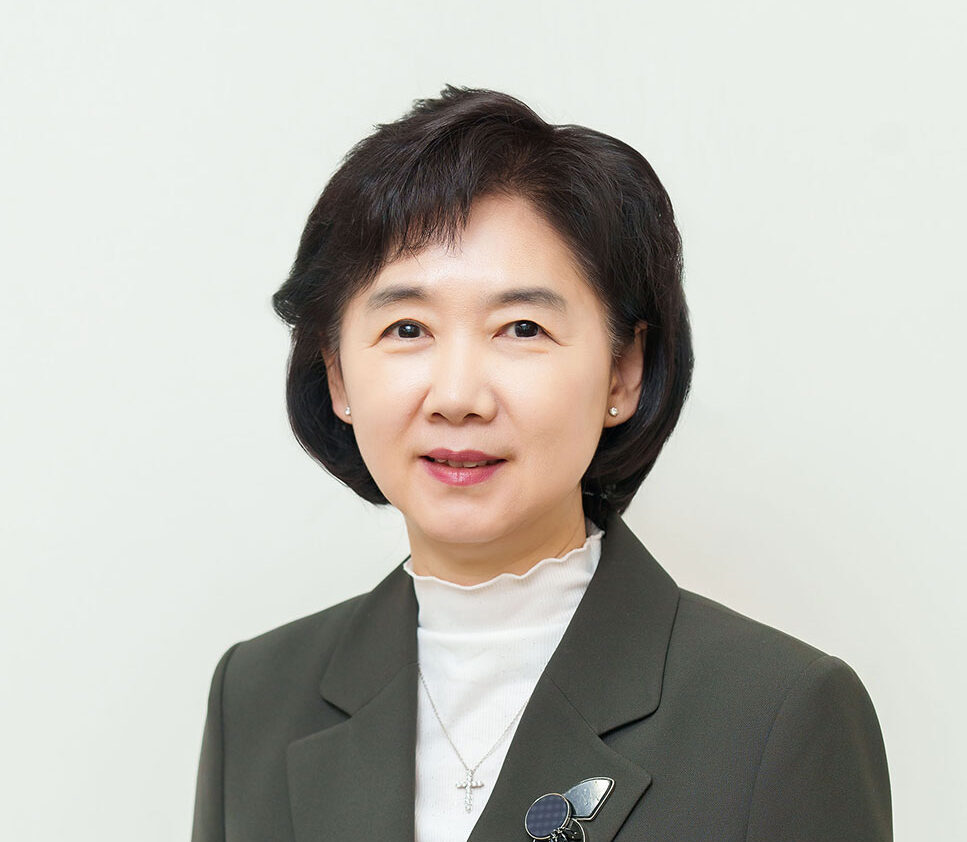
Peter Smith, MBChB, DRCOG, DCH, MRCGP.

Dr. Peter Smith Chairman Outreach EMR UK Charity no 1159060

I have spent most of my working life in General Practice in York, UK ( Haxby Group Practice ) where I was fortunate to be part of a progressive, patient centred organisation. We were also very educationally focused and teaching and training have always played a large part in my medical journey.

Much of my work was with patients from low socio economic backgrounds and I spent the last 5 years in my practice as Medical Director of an initiative to create three “Beacon Practices “ in Hull. Life expectancy is 10 years less in parts of Hull than more affluent parts of York. This is where I first came across the “ Hard to Reach “ patient and it was this concept that inspired me to broaden my horizons and work in Africa.

On my first visit to rural Uganda in 2011 I was saddened to discover that there was no permanent note keeping in the busy clinic and any scraps of paper that were written on were used in the latrine the following day! The experience of seeing my notes – about a patient with HIV – on the latrine shelf dictated my medical course from then on.

I returned to the UK and met up with Bass Stewart, a software designer. Together, we created a Primary Care focused EMR which allowed a named database, space for notes, medical coding and a simple reporting system. Our unique selling point was that people with no computer skills could become proficient users in 1 day. We have since added many more functions including pharmacy stock control, cash book and traffic light warning systems to highlight abnormal findings, using Ugandan health system requirements as our baseline.

Our software was originally designed around the Ugandan HMIS form 105 and we can report on all their required disease codes. Our clinics in Uganda now have over 180,000 computerised records.

We have a talented committee and now have 22 established clinics in 8 countries with over 300,000 patients on our databases. We are a registered charity – Outreach EMR www.outreachemr.org with several doctors who regularly visit clinics and train staff.

We have recently completed a pilot with support from the Ugandan MOH and successfully demonstrated Interoperability.